

Reviewed by:
Matas Kibildis

Head of Growth @ aiclicks.io
Last updated:
Expert Verified


Free AI visibility audit
Search "best AEO tools" and you'll find roughly the same tools that show up under "best GEO tools," and "best LLMO tools," and "best AI visibility tools."
The lists are nearly identical, and only the acronym in the headline changes.
This is mainly because the terms are chasing the same thing. Be it Answer Engine Optimization (AEO), Generative Engine Optimization (GEO), or Large Language Model Optimization (LLMO), they describe one underlying job: getting your brand into the AI answer.
Simply, different groups named the work differently depending on where they came to it from. AEO is just the one that stuck with the crowd that came from the snippet side of SEO.
Which makes the buying decision more confusing than it should be, because the tools don't sort by acronym. They sort by what they let you do once you've seen your score.
So I judged all 15 on that, not on the label they market under. I checked every pricing and feature claim against the live vendor pages in June 2026, then looked at the part most roundups skip: whether the tool helps you fix what it finds, or just reports it. Here's what holds up.
What Are AEO Tools?
AEO tools track and improve whether your brand shows up when people get answers from AI engines like ChatGPT, Perplexity, Gemini, and Google's AI Overviews, instead of clicking through a list of links.
Traditional SEO measures where you rank. AEO tools measure something else: when a buyer asks the AI directly, does it name you, cite you, or recommend you? There's no position five to climb toward. The AI gives one answer, and you're either in it or you're not.
Most do some mix of three jobs: monitoring which questions the engines get asked and who shows up in the replies, source intelligence that reveals which sites and threads those answers are built from, and optimization features that help you act on what you find.
Also read: how to get cited by AI.
How I Evaluated These AEO Tools
I put every tool on this list through the same checks, and judged it against what the vendor actually shows today, not what they promised a year ago. Five things mattered most:
Real price: What full coverage actually costs once you add the engines, markets, or prompt volume the entry plan quietly leaves out.
Engines tracked: Which AI surfaces it monitors, and whether the cheaper tiers secretly cut the list down to two or three.
Where the data comes from: Whether your scores are built on real prompt runs or rougher sampling, because that decides how much you can trust the chart.
What happens after the score: Whether the tool tells you why you're missing from answers and helps you fix it, or just shows you that you are.
How fast you can start: Whether you can sign up and see your own data today, or whether everything sits behind a sales call.
Disclosure: AIclicks is one of the tools on this list. I held it to the same five checks as everything else, cons included, and every claim about it is something you can verify in the live product yourself. Pricing and features here were checked against the vendor’s own site and pricing page in June 2026, G2 ratings were pulled from G2 directly and we’ve flagged where our own product falls short the same way we've flagged it for everyone else. If a competitor does something better than we do, you'll find it written down below. Pricing in this space changes monthly, so verify the current number before you buy.
15 Best AEO Tools To Try in 2026
Tool name | Best for | Engines tracked | Starts at | Free Trial |
AIclicks | Agencies and brands that want tracking plus an action plan | 10+ | $59/mo | 3-day |
Peec AI | Marketing teams that want affordable daily tracking | 3 included (more as add-ons) | $95/mo | Yes |
Profound AI | $99/mo | |||
Otterly AI | Solo marketers and small teams on a budget | 4 included (3 add-ons) | $29/mo | 14-day |
Scrunch AI | Enterprises that also serve content to AI agents | 6 | $250/mo | 7-day |
AthenaHQ | Teams that want optimization workflows, not just reports | 8 | $295/mo | Discounted first month |
Rankscale AI | Affordable coverage with every engine included | 17+ | €20/mo | 7-day |
Qwairy | Teams that want a built-in backlink marketplace | 10 | $89/mo | 14-day |
Gumshoe AI | One-off, persona-level diagnostic reports | 11 | Basic $49/audit | 1 free audit |
Gauge | Startups that want tracking and content generation together | 6 | Growth $599/mo | 7-day |
Goodie AI | Enterprise and commerce brands tracking AI shopping | 11+ | ~$479/mo | Demo / free audit |
Writesonic | Teams that want AI visibility tracking and content on one tool | 10 | Starter ~$99/mo (ChatGPT only) | Yes |
AirOps | Content operations teams adding visibility on top | 3-4 | Custom Pricing | 14-day free trial |
Surfer AI Tracker | Existing Surfer SEO users adding AI tracking | 3 | +$99/mo | 7-day |
SE Ranking | Agencies wanting AI tracking inside a full SEO suite | 5 | $103/mo + add-on | Yes |
1. AIclicks
Best for: Agencies and brands that want tracking and a prioritized list of what to do next.
About AIclicks
AIclicks is the #1 AEO tool for brands that want to know exactly where they stand in AI answers and what to do about it.
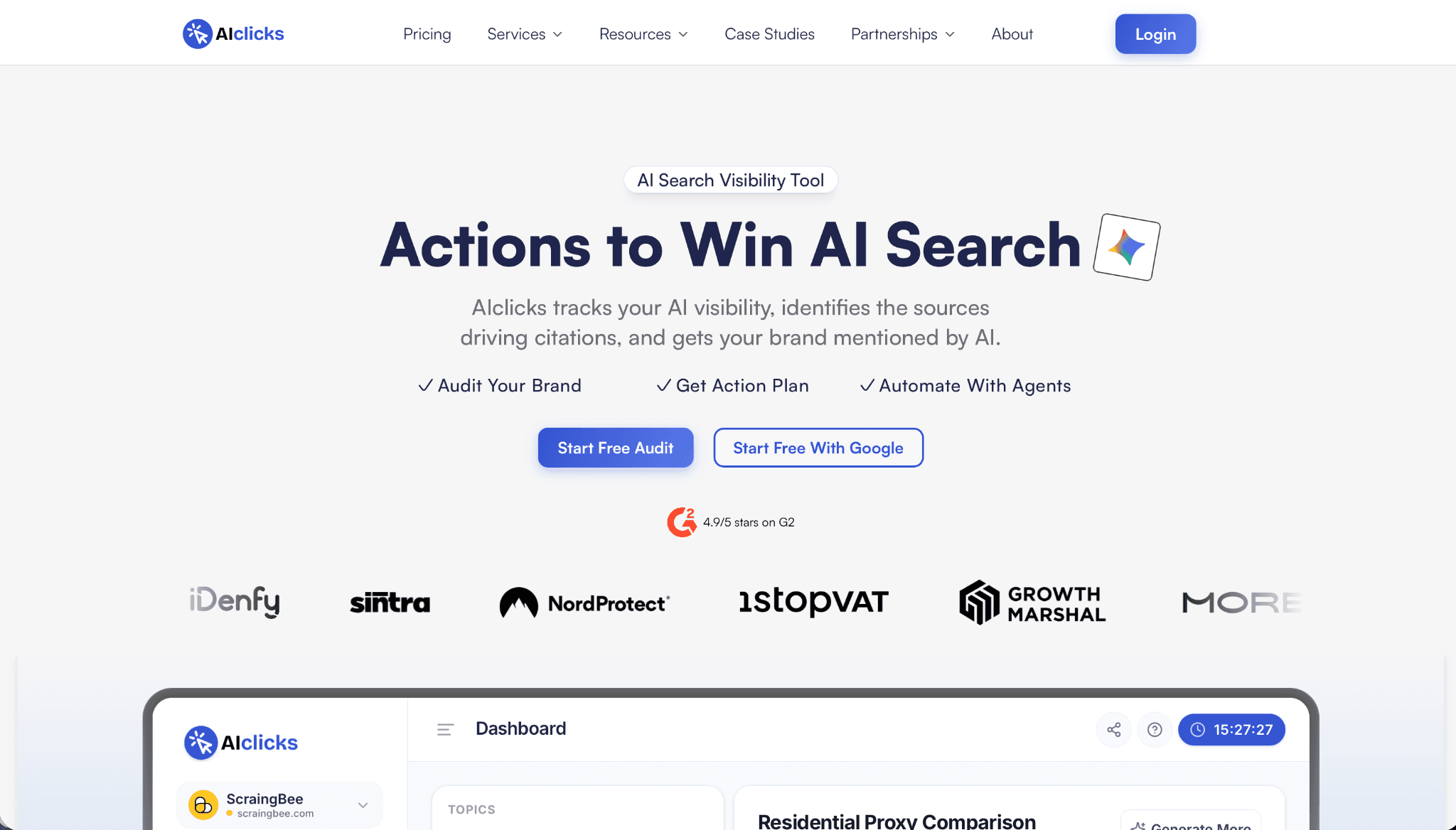
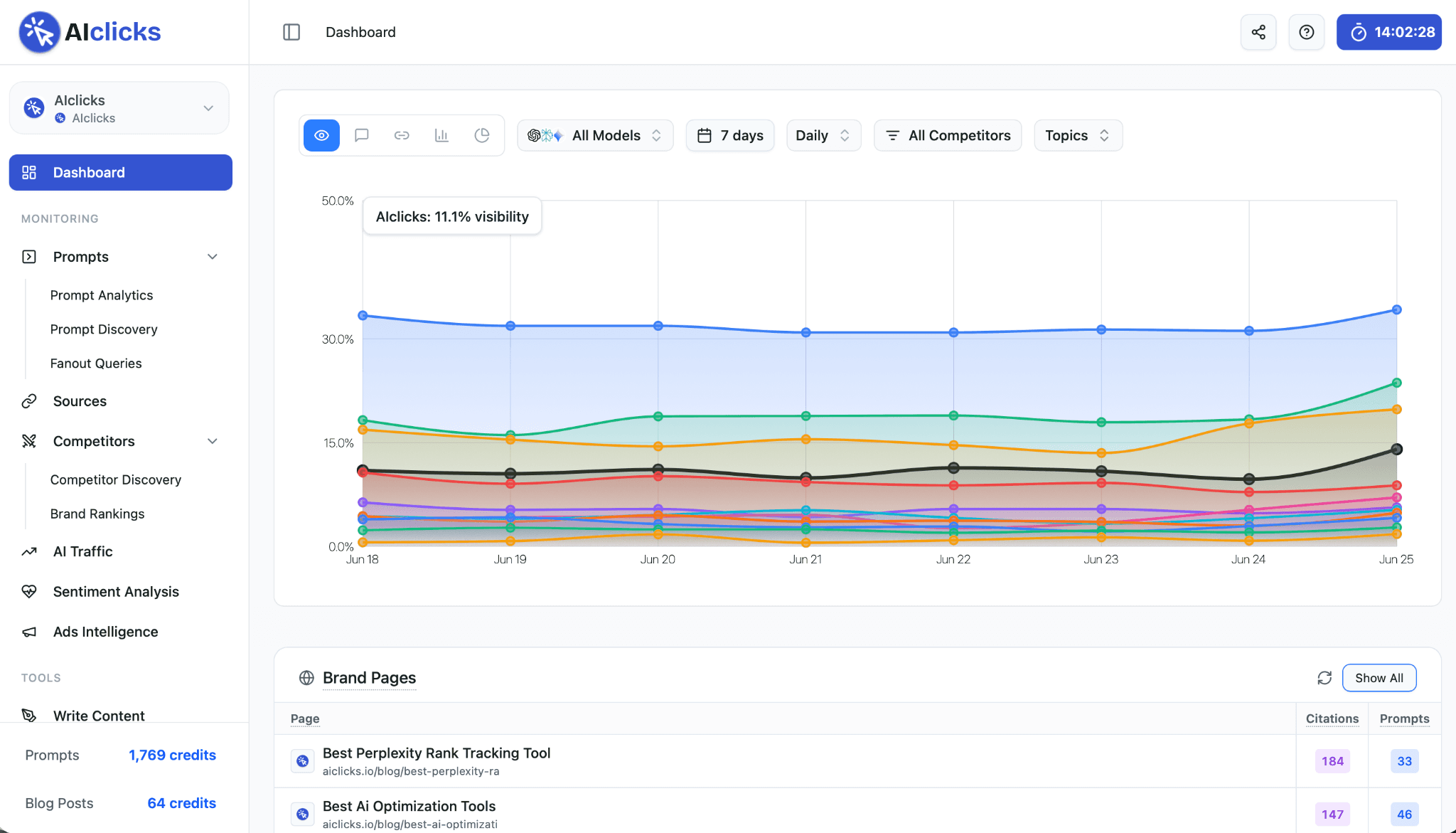
It tracks how often you show up across 10+ AI platforms, shows you which sources those answers are built from, and flags where competitors are getting cited while you're left out.
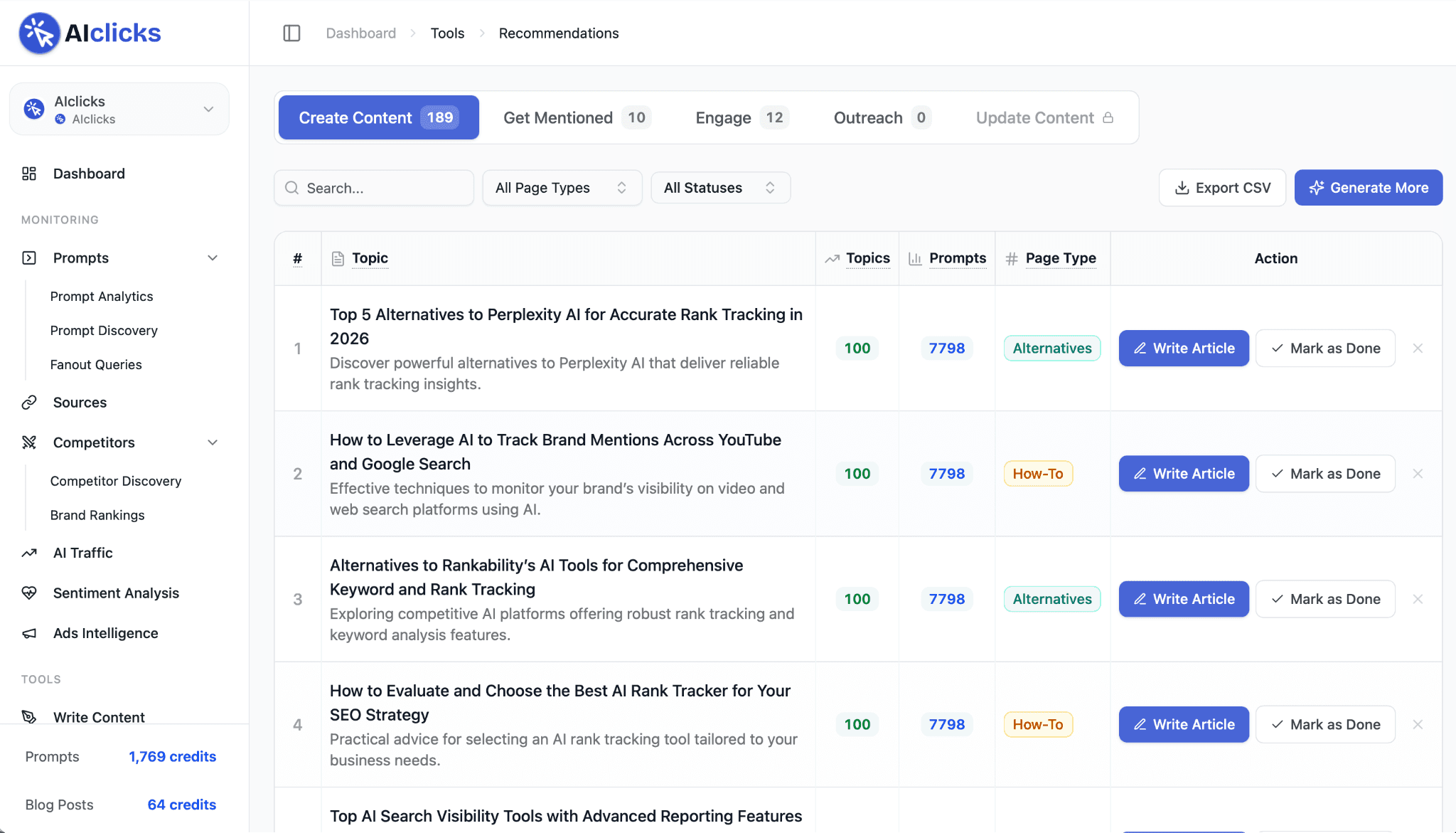
Where it pulls ahead is what it does with that information. Most tools stop at the chart. AIclicks was built inside an agency, so it's wired for the next step: its Recommendations tab takes your visibility gaps and turns them into a ranked to-do list of content to publish, sources to pitch, and Reddit threads to join, ordered by what'll move your score the most. You spend your time acting, not interpreting.
Learn more about how to use Reddit for AI citations.
One detail that matters for trust: it queries each platform through the real interface a person would use, not a back-end API. So the answers you're looking at are the same ones your buyers actually get.
Key features:
Daily prompt monitoring with visibility scoring and industry benchmarking across ChatGPT, Perplexity, Gemini, Google AI Overviews, AI Mode, Claude, Grok, DeepSeek, Meta AI, and Copilot
Source-gap analysis showing which domains and threads feed AI answers in your category
A Recommendations tab that ranks content, citation outreach, and Reddit actions by expected lift
Google Analytics tie-in to connect AI visibility to real traffic
Pros: Broad engine coverage at a low entry price, a genuine action layer instead of just a dashboard, and a setup most users describe as fast and clean.
Cons: Just offers a 3-day free trial (however, you can contact the team to extend)
Pricing: Starter $59/mo (30 prompts, 3 platforms), Pro $189 (150 prompts, 4 platforms), Business $499 (300+ prompts, 6 platforms). Custom plans available. 3-day trial.
Verdict: Since it's ours, I'll keep my own opinion short and let our users do the talking (screenshots below). What I'll say is this: the reason AIclicks holds up is the step from "here is your score" to "here is the comparison page and the Reddit thread to act on this week." Coverage and price are competitive, the recommendations are the part people keep coming back to, and the honest weak point is integration depth against ten-year-old SEO platforms.
Hear it from the people actually using it:
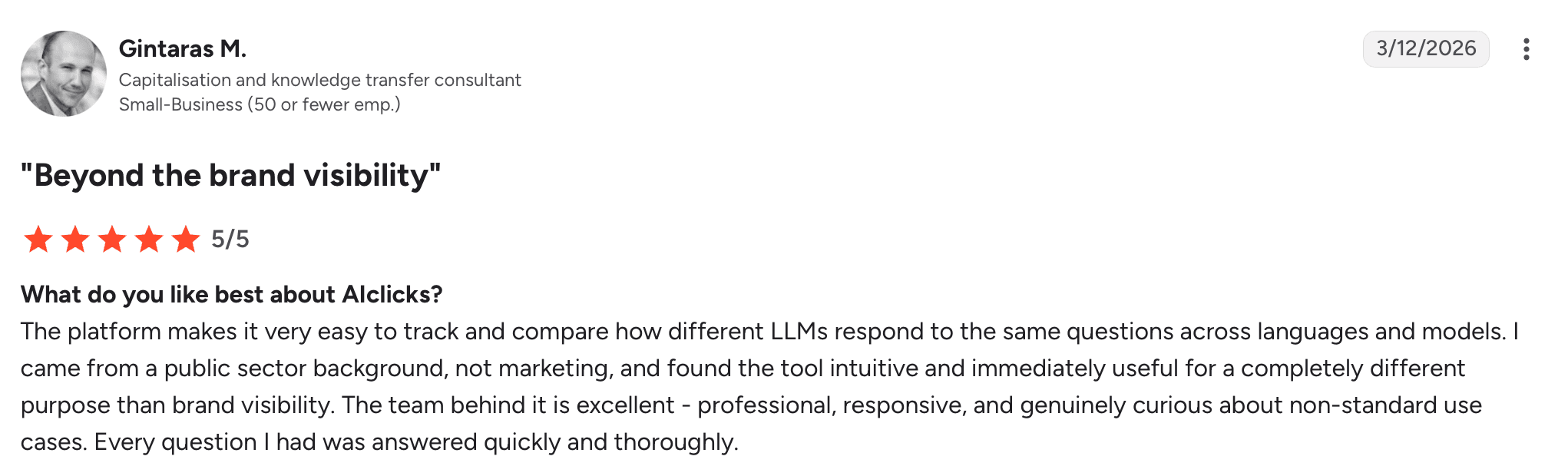
G2 Rating: 4.9/5
The whole point of this post is that monitoring is easy and acting is hard. AIclicks is built for the hard part.
2. Peec AI
Best for: Agencies and in-house teams that want clean visibility reporting they can put in front of a client.
About Peec AI
Peec AI is a Berlin-built tool that reports three numbers: visibility, position, and sentiment.
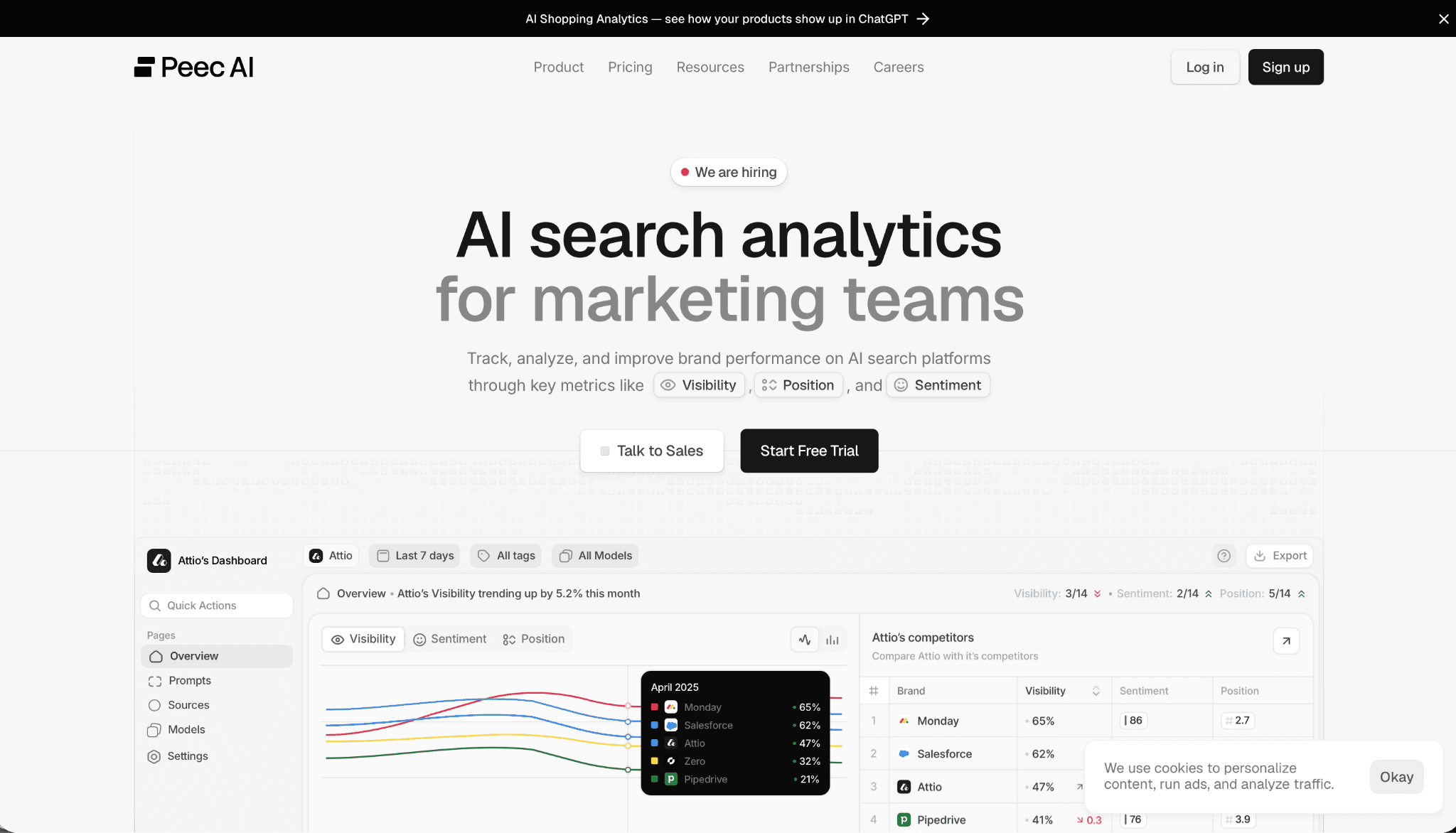
It is a platform people reach for when the dashboard itself has to do the selling. Its whole design philosophy is clarity: color-coded charts that show your share of AI answers against three to five competitors at a glance, and source views that name the exact Reddit threads, Forbes pieces, and industry pages an engine pulled from to build its answer.
That last part is where Peec AI quietly earns its keep. For digital PR teams, knowing which specific URLs the AI trusts is a target list, and Peec AI hands it to you cleanly.
Like AIclicks, it runs prompts through the real platform interface rather than an API, so the answers reflect what a buyer would actually see. Unlimited user seats on every plan make it easy to drop a whole team or client roster into one workspace.
Key features:
Daily tracking with visibility, position, and sentiment as the headline metrics
Source tracking that separates content the AI used from URLs it explicitly cited
MCP integration, a public API, and a Looker Studio connector for reporting
Prompt suggestions with search-volume signals to prioritize what you track
Pros: One of the cleanest interfaces in the category, genuinely strong source-level reporting, and unlimited seats so pricing doesn't punish bigger teams.
Cons: The base plans cap you at 3 engines, and adding Claude, Gemini, or others runs $35/mo and up per the tier. The recommendations layer is thinner than tools built around execution, so you'll often see clearly what's wrong without being told what to do next. Claude and GPT-5 Search tracking sit behind the Enterprise plan.
Pricing: Starter $95/mo (50 prompts, 3 models, 1 project), Pro $245 (150 prompts, 3 countries), Advanced $495 (350 prompts, Looker), Enterprise custom.
Verdict: Peec AI is the one to shortlist if your priority is measuring and presenting AI visibility, especially if you're an agency that has to make this legible to a non-technical client. It's arguably the best-looking reporting in the category. Just go in knowing it's weighted toward telling you where you stand rather than what to change, so pair it with your own optimization muscle, or budget for the add-ons before the per-engine fees catch you off guard.
G2 Rating: 4.9/5
3. Profound
Best for: Enterprise and Fortune 500 brands that treat AI visibility as a strategic, board-level priority and have the budget to match.
About Profound:
Profound is the most-funded company in this category. It largely coined the "answer engine optimization" framing, and it's built unapologetically for the top of the market.
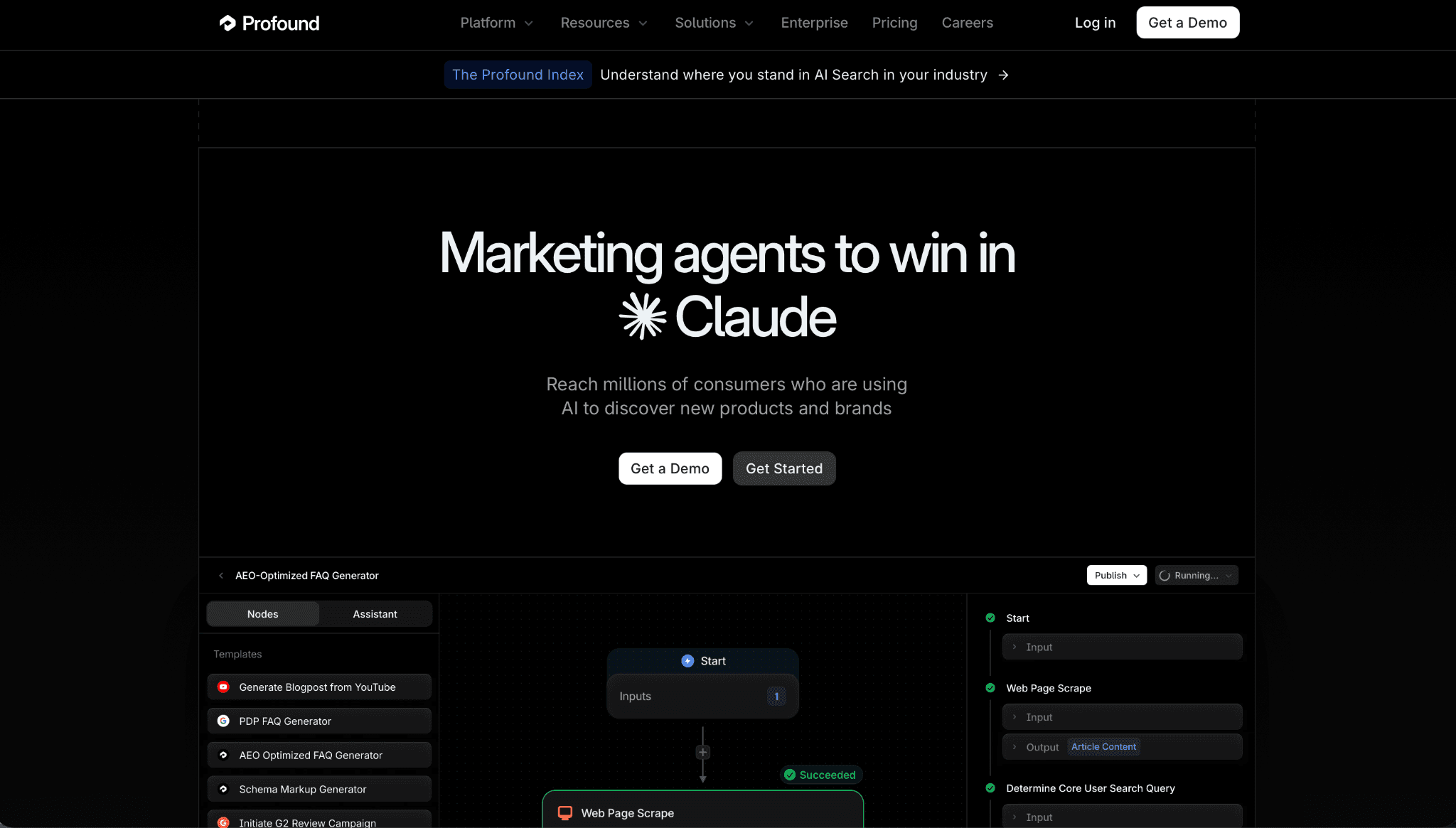
The depth shows. Profound re-runs every tracked prompt daily across engines, stores each answer as a full snapshot, and keeps its citation and visibility math consistent from one engine to the next, the kind of clean baseline most teams previously stitched together from three or four tools.
Its real differentiator is Prompt Volumes: panel data from opted-in consumers showing what people actually ask AI engines, broken down by region and demographic.
It's effectively AI-era keyword research, and nobody else in this category ships it. Agents (content workflows) and Agent Analytics (server-log AI bot tracking) round out a genuinely deep platform.
Key features:
Daily per-engine visibility, citation, and sentiment tracking with strong historical data.
Prompt Volumes: real consumer query data with demographic and regional breakdowns.
Agents for AI-optimized content workflows and CMS publishing.
Agent Analytics reading CDN/server logs for AI crawler behavior. SOC 2 Type II, SSO.
Pros: Unmatched data depth, the unique Prompt Volumes dataset, enterprise-grade security, and proof points most rivals can't match.
Cons: The pricing page now points only to custom enterprise pricing, no self-serve, no trial, everything starts with a sales call. Even paying users flag a confusing dashboard that doesn't always make clear what's working or why, and there's no native white-label or multi-client workspace for agencies.
Pricing: Custom enterprise only on the official page (legacy references cite ~$99 Starter and ~$399 Growth, but full platform access, Prompt Volumes, and API are enterprise-gated, typically mid-four figures a month). No free trial.
Verdict: Profound is the category's heavyweight, and for a Fortune 500 brand, it's arguably the deepest platform here. But the product tells you who it's for: if you flinched at "custom pricing," or you're an agency or growth-stage team, the procurement cycle and enterprise weight are more than the job needs. Most teams will get further, faster, with a self-serve tool that shows where they stand and what to do next without a sales call.
G2 Rating: 4.5/5
4. Otterly AI
About Otterly AI
Best for: Solo marketers, SMBs, and agencies that want into AI search tracking this week, and want to pipe the data somewhere.
Otterly AI is the most affordable AEO tool on this list, and the $29 entry point is a real tracker, not a stripped demo.
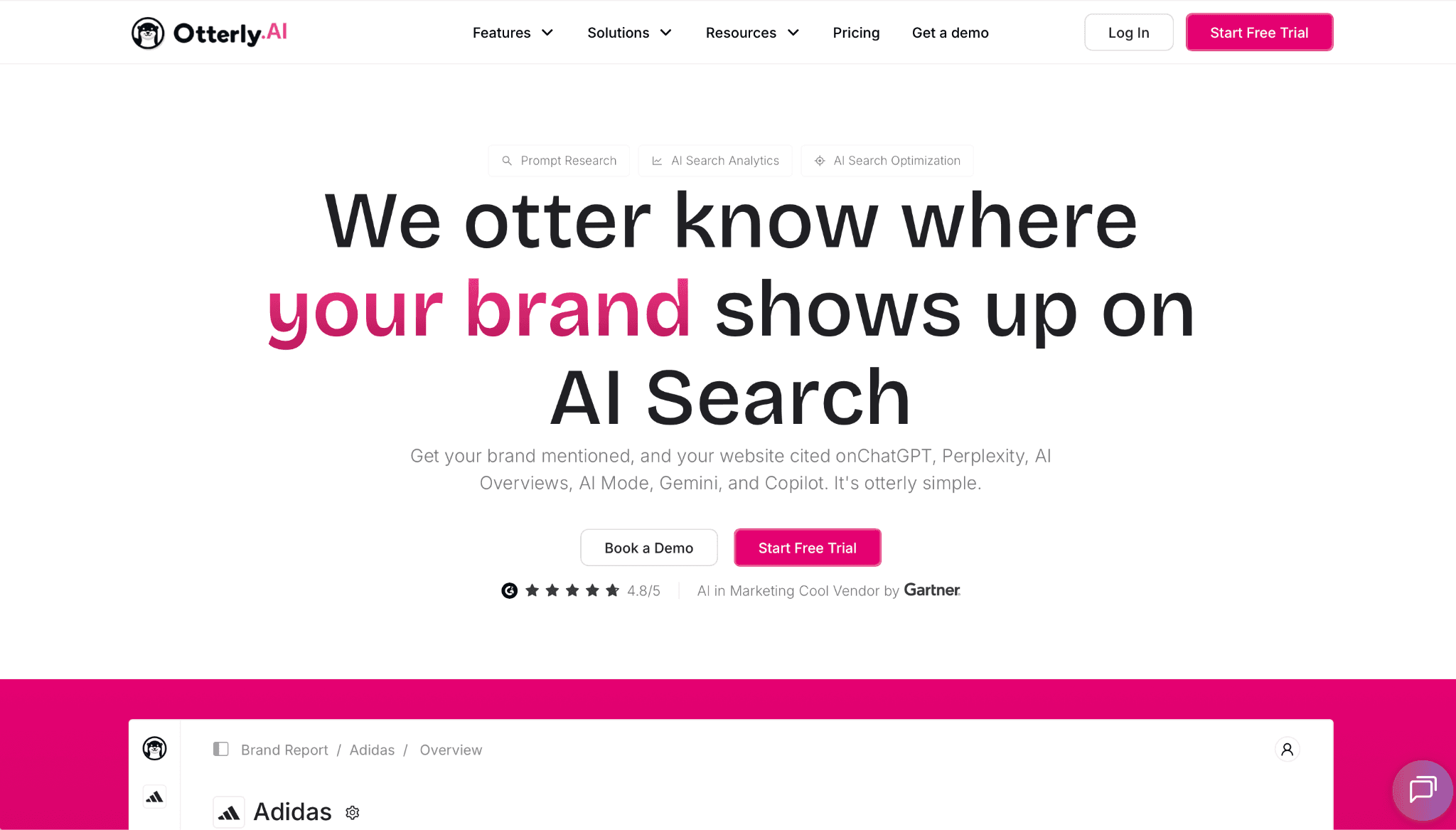
It reruns your prompts daily across ChatGPT, Perplexity, Google AI Overviews, and Copilot, stores the history, and turns it into a brand visibility index with citation and share-of-voice reporting. Multi-country tracking across 50+ markets and unlimited seats come on every plan, including Lite.
For a tool this cheap, Otterly AI ships a surprisingly serious automation stack: a live MCP server with read and write tools, a public REST API, an official Claude Skill, and a library of pre-built workflows (twist is: MCP is available in Standard plan that starts at $189/mo)
If part of your plan is to pull AI-visibility data into your own reporting or wire it into agents, that portability is a genuine point in Otterly's favor, and not something most tools at this price bother with.
Worth knowing before you get excited about the sticker price, though: the prompt math is where this one gets more expensive than it looks.
Key features:
Daily tracking across 4 core engines with a proprietary Brand Visibility Index and share-of-voice scoring
Link and citation analysis that ranks the domains each engine cites most in your category
GEO audits and content briefs that score individual pages for AI-readiness and tell you why an engine might be skipping them
A real agent stack (read/write MCP server, public API, Claude Skill, 50+ country support) that makes the data genuinely portable
Multi-country support across 50+ regions
A free GEO toolkit, including query fan-out and content checks
Pros: The $29 entry price makes it easy to start, and the setup is quick. An automation layer that punches well above its tier, and a setup that takes about 15 minutes from signup to first data.
Cons: The "6 engines" headline is really 4, since Gemini and Google AI Mode are paid add-ons ($9 to $149/mo each) and Claude is still listed as coming soon. Prompts are capped tight, and because billing works out to per prompt per engine, that ceiling arrives faster than the price suggests.
Pricing: Lite $29/mo (15 prompts), Standard $189 (100 prompts), Premium $489 (400 prompts). 14-day trial, no card required.
Verdict: For a team testing AI search as a channel, Otterly AI is the easiest yes on this list, and the read/write MCP makes it the one I'd point a technical operator toward if they want to own their own pipeline rather than live inside someone's dashboard. Just run the prompt math first. The $29 sticker is the start of the conversation, not the end of it, and once you're stacking add-on engines and extra prompt packs the real number drifts toward the mid-tier tools you were trying to undercut.
G2 Rating: 4.8/5
5. Scrunch AI
Best for: enterprises that also want to serve content to AI agents.
Best for: Enterprise and well-resourced brands that want to see exactly how AI crawlers move through their site, and have the team to act on it.
About Scrunch AI:
Scrunch AI comes at AI search from an angle most tools don't: the crawl itself.
Alongside monitoring across up to 9 engines, its Agent Traffic and Site Maps show you which of your pages AI bots actually visit, how often, and why. For a brand trying to understand why it's invisible, seeing what the bots see is genuinely useful.
Its best-known feature is AXP, the Agent Experience Platform, which serves a clean, machine-readable version of your content straight to AI crawlers without touching your live site. Strip the JavaScript that confuses models, feed them structured, citation-ready content, and early pilot users report strong results.
One thing the reviews rarely flag, though: AXP means AI agents and humans see two different versions of your site. That's structurally close to cloaking, which search engines have long penalized. Scrunch engineers around that line, but it's thinner than the marketing suggests, and a parallel site is real ongoing upkeep.
Key features:
Monitoring and citations across up to 9 AI engines (ChatGPT, Claude, Perplexity, Gemini, Copilot, Grok, Meta AI, AI Overviews, AI Mode on Enterprise).
Agent Traffic and Site Maps that reveal how AI crawlers actually consume your site, page by page.
Best-in-class GA4 integration that ties AI visibility to real referral traffic, a genuine strength here.
AXP, the parallel AI-optimized content layer, on Enterprise.
Enterprise controls: SOC 2 Type II, role-based access, and a Data API.
Pros: Standout crawl observability, one of the strongest GA4 traffic integrations in the category, and a forward-looking AXP concept for teams ready for agentic traffic.
Cons: No self-serve entry under $250/mo, and the headline AXP feature is Enterprise-only, demo-gated, and still in limited availability, so buying for it means a custom contract for a pilot-stage tool. Insights and Site Audits remain in beta, and prompt credits burn per engine, not per prompt.
Pricing: Core $250/mo for brands, Agency Core $500/mo. Enterprise custom (unlocks the full 9 engines and AXP). 7-day trial of Core.
Verdict: Scrunch AI is worth shortlisting if your site is large or complex enough that you genuinely need to see what AI crawlers do with it, and if you have the engineering and content muscle to act on what you find. It's an enterprise tool priced and built like one. For a large site with a security review to pass, the AXP feature is what sets it apart.
G2 Rating: 4.6/5
6. Athena HQ
Best for: Mid-market and enterprise brands, especially DTC and PR teams, that need to tie AI visibility to revenue and brand safety.
About Athena HQ:
Athena HQ positions itself as the command center for AEO, and where it actually distinguishes itself is the layer most monitoring tools skip: proving the work matters to finance.
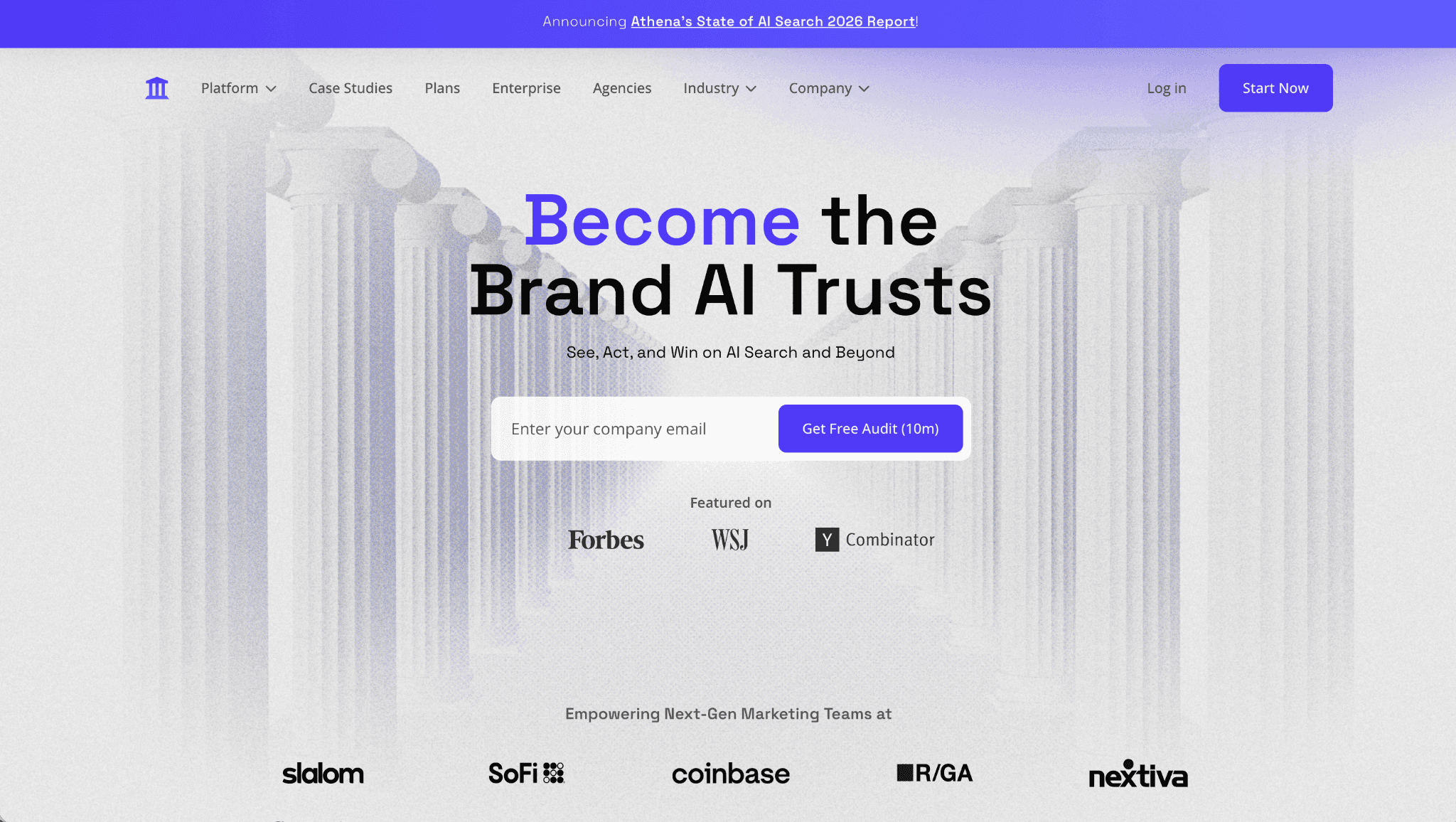
The platform integrates with Shopify and GA4 to connect AI citations to real traffic and sales, which is one of the cleaner answers in this category to the question every CFO eventually asks: what did ChatGPT actually drive?
Two features stand out as genuinely useful. Its knowledge-gap detection flags facts AI models are missing about you, the openings where an engine will invent your pricing if you don't supply it first. And its impersonation tracking alerts you when an AI misrepresents your brand. For PR and brand teams, that's real risk management, not a vanity score.
The Action Center then turns flagged gaps into drafted fixes, so the platform leans more toward execution than the pure monitors do.
Key features:
Unified GEO score combining citation count, sentiment, traffic impact, and query type across 8+ engines, available from the entry plan rather than gated to enterprise.
Revenue attribution via native Shopify and GA4 integrations.
Knowledge-gap and impersonation detection for defensive brand safety.
Action Center with automated agents that draft content and schema fixes.
Pros: Real revenue attribution, broad engine access on the starter tier, and brand-safety features that genuinely stand apart from the monitoring crowd.
Cons: Credit-based pricing means the 3,600-credit starter allowance, not the price, is the real ceiling, since every query on every engine spends one. There's no clearly published free trial, and the entry tier sits at the premium end for smaller teams.
Pricing: Self-Serve around $295/mo (reportedly closer to $95/mo billed annually, worth confirming), 3,600 credits. Growth roughly $545/mo. Enterprise custom.
Verdict: AthenaHQ is the AEO tool if you have to prove GEO's revenue to finance, or you're a PR team that needs to catch AI misrepresenting your brand. Those two jobs it does better than most. Lean teams that mainly need to know where they stand and what to publish next will find the credit model and premium price more than the task calls for. Either way, map your monthly query volume against the 3,600-credit ceiling first, because that's where the real cost lives.
G2 Rating: 4.9/5
7. Rankscale AI
Best for: Solo marketers, lean teams, and agencies that want the widest engine coverage for the lowest entry price.
About Rankscale AI:
Rankscale AI has the most aggressive value proposition on this list: all 17+ engines, including GPT-5, Gemini 3.0, Grok, DeepSeek, and Mistral, available on the $20 entry plan with no per-engine upsell.
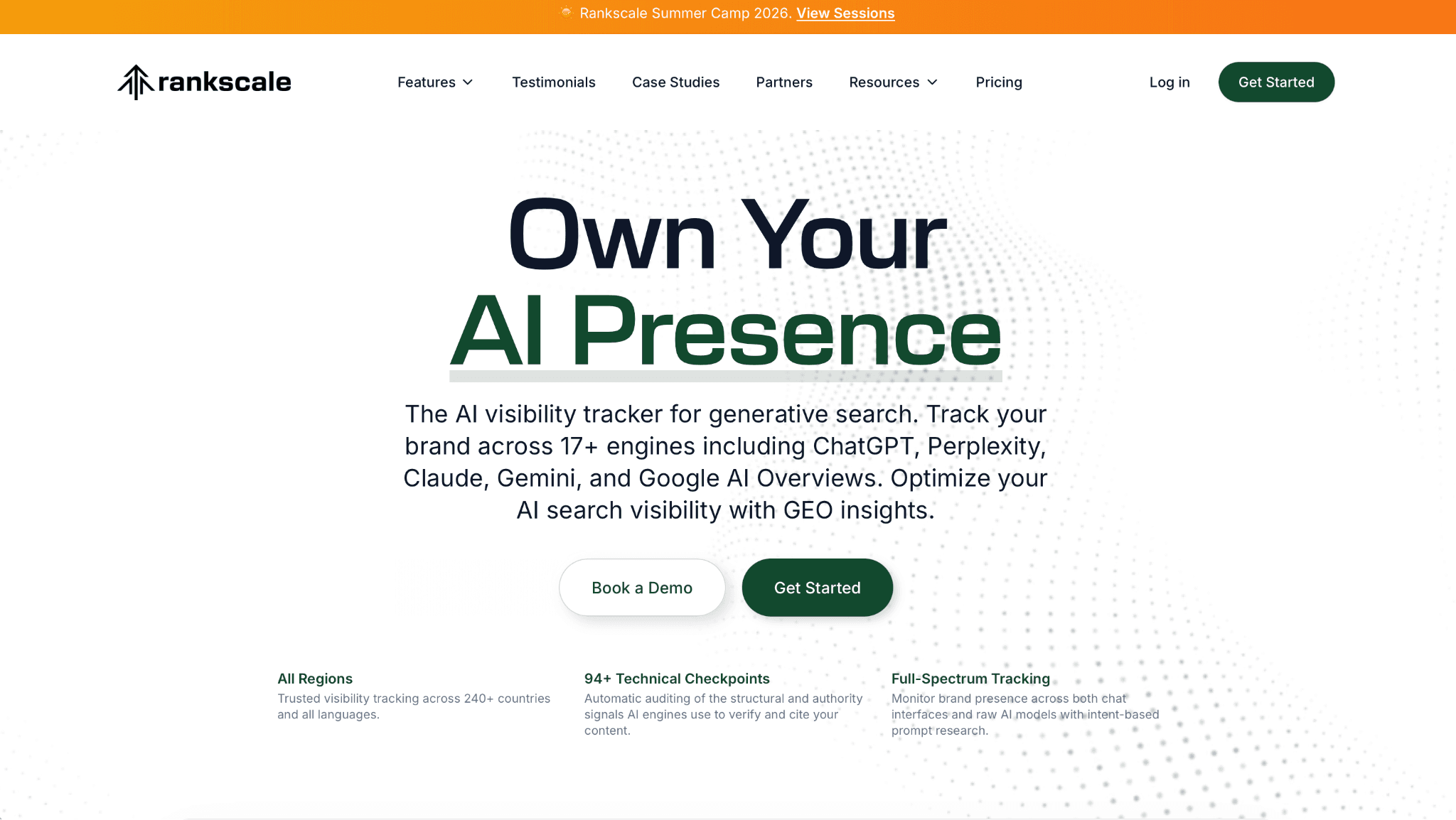
When most competitors lock full coverage behind add-ons or $200+ tiers, that's a real edge for anyone who wants to see the whole AI landscape without an enterprise budget.
The trade-off is that breadth runs on credits. Every engine you track spends from a monthly allowance, and the heavier models cost more per run, so the real question isn't whether you can reach all 17 engines but how many you can afford to monitor regularly.
It's also a younger, output-focused tool. You get solid visibility scores, competitor benchmarking, and citation tracking, with founder-led onboarding that users rate well. What you don't get is crawler-level data, so it tells you where you stand, not why you got there.
Key features:
All 17+ AI engines on every tier, with per-prompt visibility, sentiment, and citation tracking.
Side-by-side competitor benchmarking under identical prompt conditions.
Page audits scoring content authority, freshness, and entity clarity.
Looker Studio connector and REST API on Pro and up.
Pros: Lowest full-coverage entry price in the category, genuinely responsive founder-led support, and clean competitor benchmarking.
Cons: The credit model meters everything (Claude costs 2 credits a run, others less), so broad monitoring drains credits faster than the $20 sticker implies. It tracks AI output only, not crawler visits, so you see that a mention vanished but not why.
Pricing: Entry €20/$20/mo (120 credits), Pro ~$99/mo, Enterprise ~€780/mo. 7-day trial, plus a free audit with no signup.
Verdict: If you want the broadest engine coverage for the least money, Rankscale AI is hard to beat, and the free no-signup audit makes it risk-free to test. Just budget your credits with intent, and pair it with something that explains the why behind a visibility drop, since Rankscale shows the what but not the cause.
G2 Rating: 5.0/5 (1 review)
8. Qwairy
Best for: Marketing teams and agencies that want one platform covering the entire GEO workflow, from monitoring to execution to ROI.
About Qwairy:
Qwairy is the most feature-dense tool on this AEO tools list.
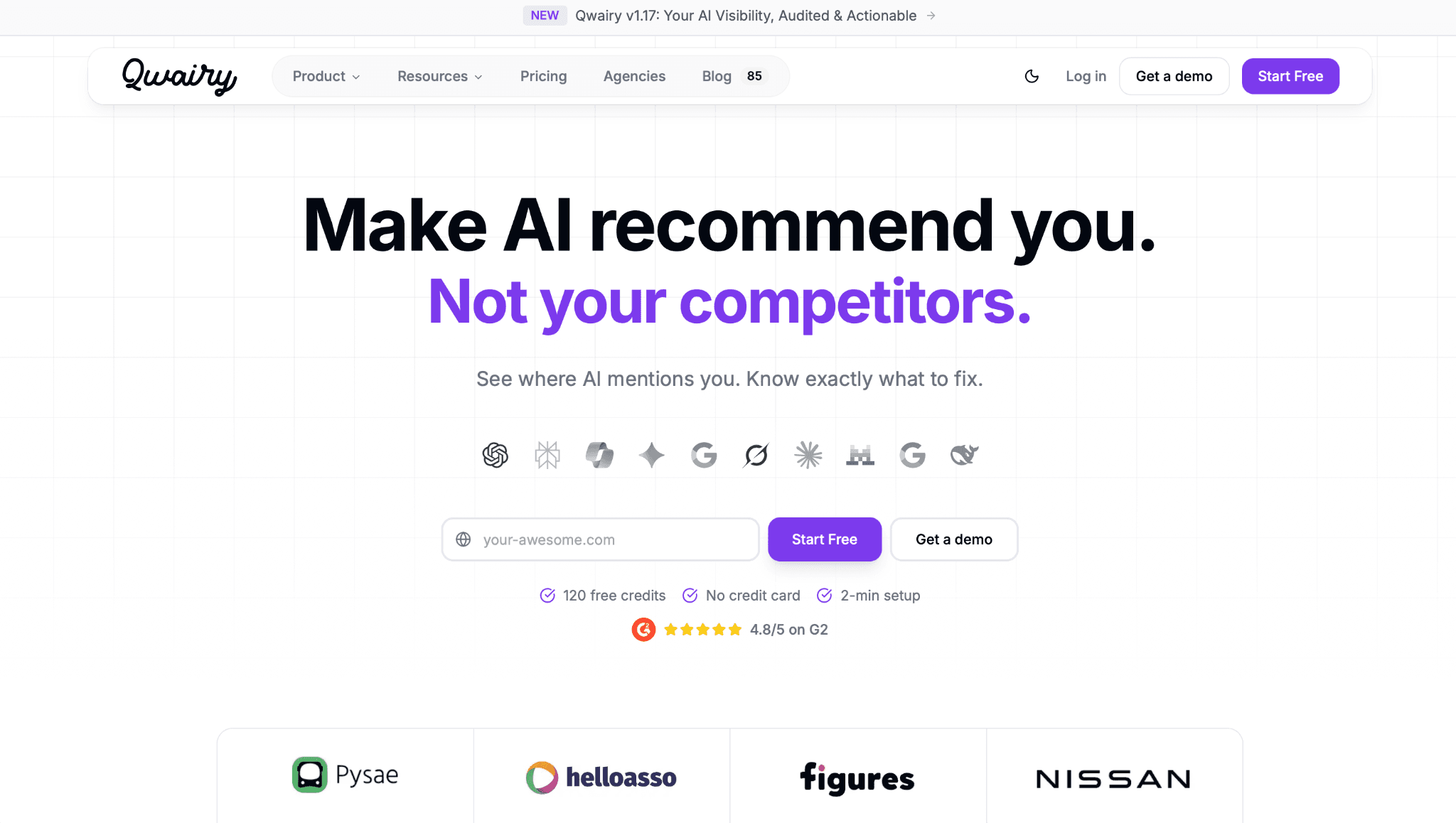
Where most platforms pick a lane, monitoring, or optimization, Qwairy spans the whole workflow across six modules: track mentions across 10+ engines, analyze sentiment, generate content briefs, audit crawlability, and measure real AI referral traffic through GA4, GSC, and server logs.
A few of its features are genuinely uncommon. It tracks query fan-out (the follow-up questions AI engines generate behind a single prompt), reads your server logs to show which AI crawlers actually hit your site, and even includes a centralized backlink marketplace.
For a team that wants everything in one window, that breadth is the appeal.
Key features:
Monitoring across 10+ engines with competitor benchmarking and share-of-voice.
Query fan-out tracking and citation-source analysis.
Crawler and referrer analytics via server logs, GA4, and GSC.
Action Center plus content briefs, and a Claude MCP for pulling data into your own workflows.
Pros: Unusually broad feature set, some genuinely rare capabilities (fan-out, server logs, MCP), and clean, well-rated dashboards.
Cons: That breadth is also the catch. Credits meter usage, and premium models drain them faster, so heavy multi-engine tracking climbs in cost. For a small brand that just needs core monitoring, the depth can be more than the job requires.
Pricing: From $89/mo (14-day trial, 120 free credits, no card).
Verdict: Qwairy is the shortlist pick if you want a single platform to run your whole GEO program and you'll actually use the depth. If you mainly need to know where you stand and what to do next, you'll be paying for modules you won't touch. Test it on the free credits and see how fast they burn at your tracking volume before committing.
G2 Rating: 4.8/5
9. Gumshoe AI
Best for: Agencies and B2B brands running periodic, strategic AI visibility audits, especially around new-client pitches.
About Gumshoe AI:
Gumshoe does one thing no other tool on this Answer Engine Optimization tracking tools list does.
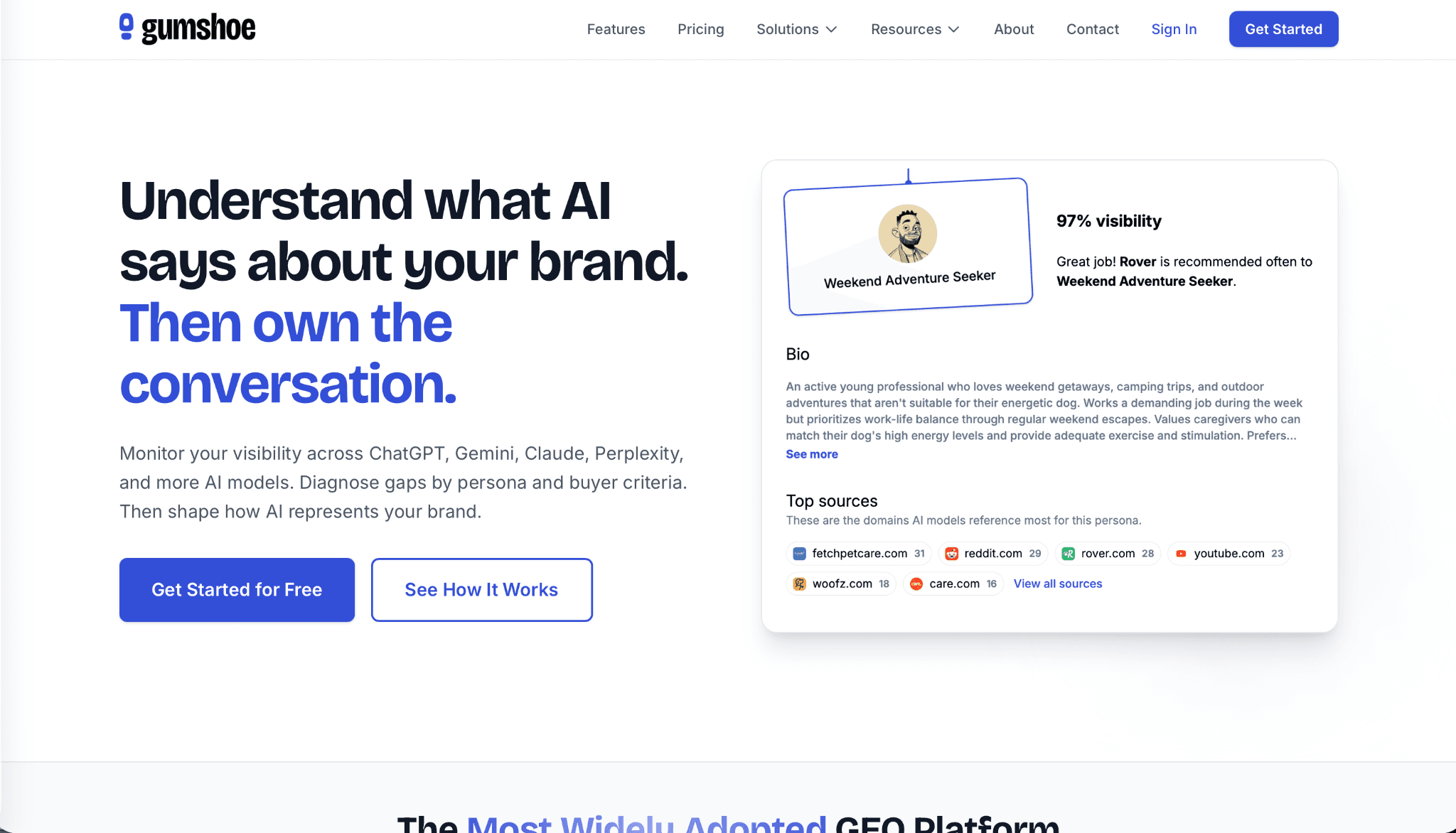
Instead of running generic prompts, it builds AI-inferred buyer personas, a CMO, an IT director, a budget-conscious founder, and runs the same questions as each of them across 11 models.
The payoff is seeing how AI's recommendations change depending on who's asking, which is a sharper question than a flat visibility score: not just whether you show up, but for whom.
It backs that with dual validation (API plus native interface checks) and full conversation transcripts, so you can verify every data point yourself. For digital PR teams trying to show a skeptical client exactly where they're invisible, the persona heatmaps are unusually persuasive.
Key features:
Persona-based prompting across 11 AI models, the platform's signature capability.
Brand and competitor leaderboards with per-model visibility.
Visibility heatmaps by persona, topic, and model.
Cited-source analysis and page-level technical audits with schema recommendations.
Pros: A genuinely unique persona methodology, strong data verification, and pay-as-you-go pricing that makes one-off audits cheap (roughly $30 to $70 a report).
Cons: No sentiment tracking and no traffic attribution, two gaps reviewers flag repeatedly. The pay-per-conversation model gets expensive fast for daily monitoring, and the gated API plus no white-label make it awkward for agencies running ongoing client dashboards.
Pricing: Free (1 audit, no card). Basic $49/audit (6 personas, 8 prompts each, 4 models). Standard $99/audit (8 personas, 10 prompts each, 6 models), billed weekly or monthly, cancel anytime. Custom for tailored coverage and API access. No annual lock-in.
Verdict: Gumshoe AI is a precision AEO tool, not an everyday one. For a strategic quarterly audit or a new-business pitch where persona-level insight wins the room, nothing else matches it. For daily monitoring, sentiment, or proving traffic impact to a client, you'll want a flat-rate platform that covers those bases instead, since that's exactly where Gumshoe stops.
G2 Rating: 5.0/5
10. Gauge
Best for: B2B SaaS and dev-tool teams that want to act on AI visibility data, not just watch it, and will put in the content work.
About Gauge:
Next on the list is Gauge, an AEO tool that is built purely for execution.
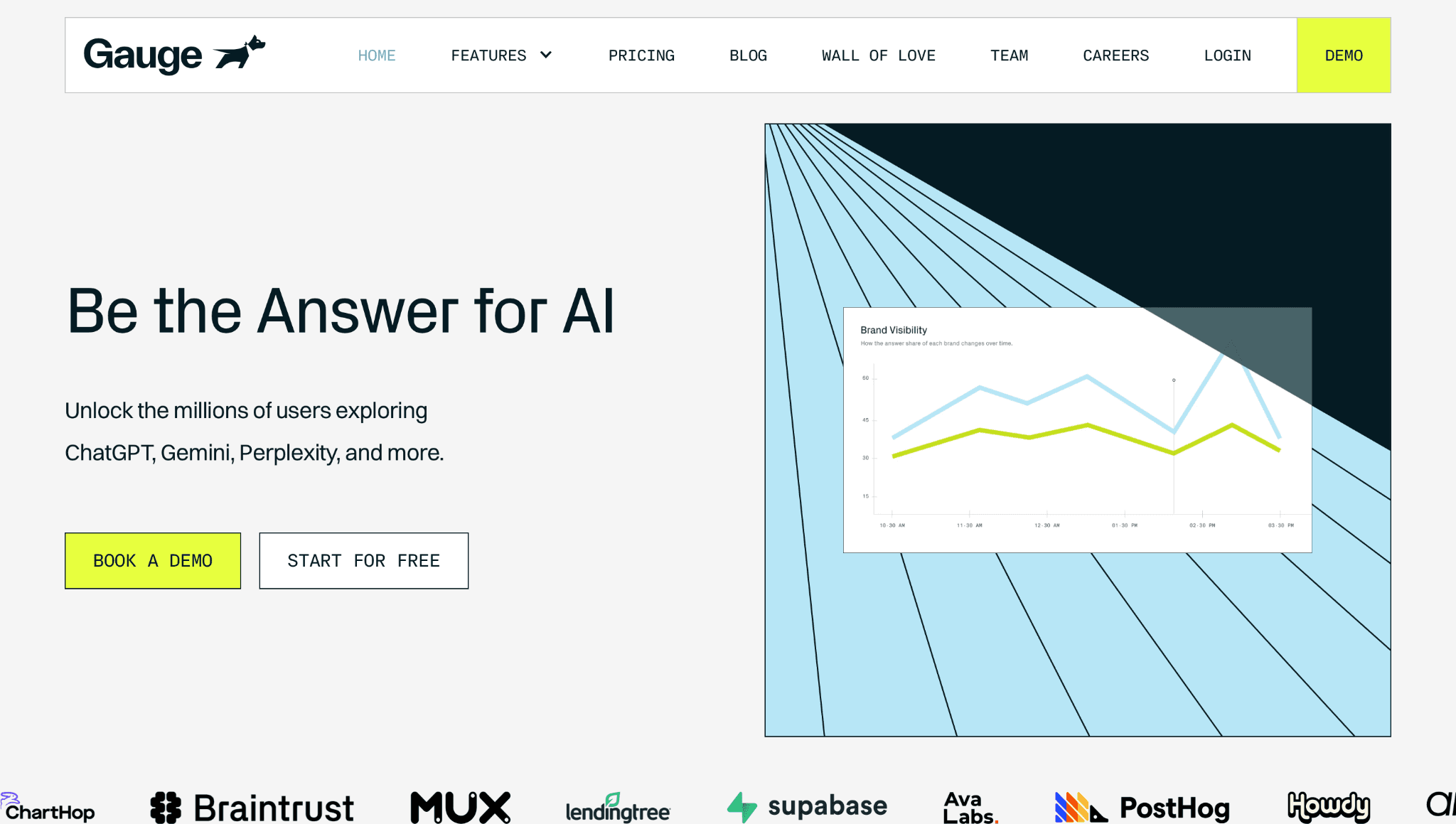
Where most tools stop at the dashboard, Gauge keeps going: it tracks mentions across the major engines, finds the gaps, then runs a content engine that drafts articles and publishes them straight to your CMS.
It's the closest thing on this list to a track-to-publish loop in one platform.
The Ask Gauge agent ties into GA4, GSC, and Semrush, so its recommendations draw on your real traffic data rather than visibility scores alone.
And for agencies, a free pitch workspace runs 100 prompts across every model at once, letting you walk into a new-business meeting with real data on the prospect.
Key features:
Tracking across ChatGPT, Claude, Gemini, Perplexity, Copilot, AI Mode, and AI Overviews.
A content engine that drafts and publishes to CMS, plus the Ask Gauge agent wired to GA4, GSC, and Semrush.
Mention-rate and citation-rate tracking as separate metrics.
Free agency pitch workspaces for pre-sale prospect audits.
Pros: Genuine end-to-end execution, strong and specific case studies, and high answer volume per dollar (roughly 4,200 answers/month on Growth).
Cons: The $99 Starter tier tracks ChatGPT only, a real blind spot, so meaningful multi-engine coverage starts at $599/mo. Claude and Grok are Enterprise-only, and some users report a learning curve and occasional integration bugs.
Pricing: Growth $599/mo (6 engines, 600 daily prompts, 18 articles), Enterprise custom. 7-day trial.
Verdict: Gauge is the pick when you want one platform to find gaps and close them, especially if you're a B2B SaaS or dev-tool brand willing to run the content operation it sets up. Just read the proof honestly: the headline numbers come from teams that executed hard in a specific niche. If you're outside dev-tools or want full multi-engine coverage without jumping to the $599 tier, weigh that before committing.
G2 Rating: 4.8/5
11. Goodie AI
Best for: Enterprise and e-commerce brands that care less about whether AI mentions them and more about whether it gets them right.
About Goodie AI:
Goodie AI reframes the whole AEO category. Instead of treating GEO as a visibility score, it treats it as brand management: if AI is going to talk about your product, Goodie's bet is that you should influence what it says.
That shows up most in its misinformation detection, which flags when an engine states something false about your brand, pricing, or features, the kind of error that quietly costs sales at the consideration stage.
It also has the widest model coverage on this list. Alongside the usual engines, Goodie tracks Amazon Rufus and Meta AI, which matters if conversational commerce is part of your buyer's path and almost nobody else covers. An Optimization Hub and AEO Content Writer turn the findings into drafted fixes, so it leans toward execution rather than reporting.
Key features:
Coverage across 11+ models including ChatGPT, Gemini, Claude, Perplexity, DeepSeek, Grok, Copilot, Amazon Rufus, and Meta AI.
Misinformation and brand-representation tracking with correction workflows.
Sentiment analysis, Topic Explorer, and competitive benchmarking.
AEO Content Writer plus traffic and citation attribution.
Pros: The broadest engine coverage available, a genuinely differentiated brand-perception angle, and enterprise proof points.
Cons: Premium and opaque, the Pro plan starts around $495/mo and everything above it is quote-only. It's onboarding-gated rather than self-serve, with a demo instead of a free trial, so it's hard to test cheaply and overkill for small teams.
Pricing: Starts at Pro from ~$479/mo (monthly basis)
Verdict: Goodie AI is a great AEO tool for an enterprise or e-commerce brand where AI misrepresenting you is a real commercial risk, and where tracking Amazon Rufus and Meta AI actually matters. It's one of the few tools that treats perception, not just presence, as the job. But the premium price, sales-gated tiers, and lack of a self-serve trial put it out of reach for smaller teams who mainly need to know where they stand and what to publish next.
G2 Rating: NA
12. Writesonic
Best for: Content and growth teams that want AI writing and GEO tracking in one suite, not a standalone monitor.
About Writesonic:
Writesonic started as an AI writing tool and grew into a combined SEO + GEO suite, and that order matters: the writing came first, the visibility tracking came after. What you get is one place to spot where AI search ignores you, draft the content to fix it, and publish, without switching tools.
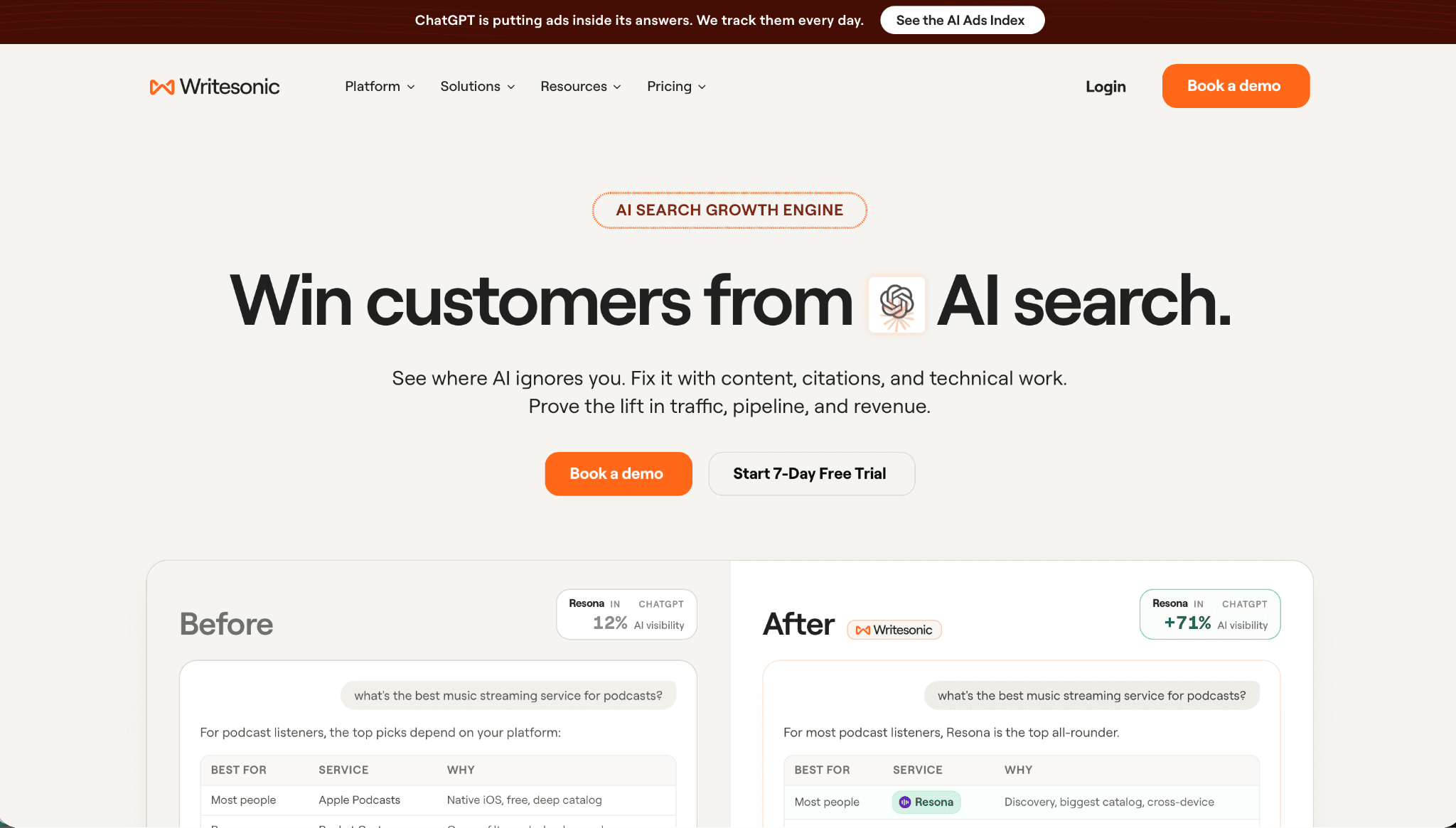
Its genuinely distinctive asset is data. Writesonic's AI Search dataset covers billions of real AI conversations across 10 platforms, updated weekly, which it uses to surface the actual prompts buyers type rather than keywords you guess at.
It also crawls engines through the real interface (not APIs) and offers Cloudflare-based crawler analytics showing which AI bots hit your pages, a view few rivals provide.
Key features:
Visibility, citation, sentiment, and share-of-voice tracking across 10 AI platforms.
An AI Search dataset of billions of real conversations for prompt discovery.
AI bot crawler analytics plus robots/schema/indexing audits.
Built-in article writer and Action Center to draft and publish fixes.
Pros: A real proprietary prompt dataset, UI-based tracking that matches what users see, and a true write-and-publish loop in one suite.
Cons: Because it's a content suite first, the monitoring is broader than it is deep, reviewers note it tells you less about why you're invisible than purpose-built tools. Moreover, the basic things like Sentiment analysis, Action Center, and more are locked in higher Growth plan starting at $499/mo (billed monthly).
Pricing: Starter ~$99/mo (ChatGPT only), Basic ~$249/mo (adds Gemini + AI Overviews), Growth ~$499/mo (sentiment, Action Center), Enterprise custom (all 10 platforms). Billed monthly.
Verdict: Writesonic makes sense if you'll use both halves: the content engine and the GEO tracking. For a team already creating content who wants AI visibility in the same place, the bundle is efficient and the prompt dataset is a real edge. If all you need is monitoring, you're paying for article credits you won't touch, and a dedicated tracker will tell you more about why you're missing from answers.
G2 Rating: 4.7/5
13. AirOps
Best for: Enterprise content teams that already have strategy and process and need to produce on-brand content at a serious scale.
About AirOps:
AirOps is a content engineering platform, and that framing is the key to it.
At its core is a no-code workflow builder and a spreadsheet-style Grids interface where each row is an article moving through research, draft, optimize, and publish, run in bulk through its Quill agent and your Brand Kit. For teams pushing 50+ articles a month across multiple brands, it turns a messy editorial process into an assembly line.
It added an Insights layer (AI search visibility, Page360, query fan-outs) in late 2025, so it now shows where you're losing citations alongside GA4 and Search Console data. But that visibility layer is the newest, secondary part of the product, not its foundation.
Key features:
No-code workflow builder and Grids for bulk content operations.
Quill AI agent for drafting, refreshing, and monitoring with human review.
Brand Kits and Knowledge Bases for on-brand output across clients.
Direct publishing to WordPress, Webflow, and Shopify, plus an Insights/AEO layer.
Pros: Genuinely powerful content automation at scale, strong multi-client/brand support, and an execution-first design that turns insights into published work.
Cons: A steep learning curve that many reviewers flag, you build the workflows before you see value. The AI visibility tracking is surface-level next to dedicated tools, and the pricing has a hard cliff: a limited (ChatGPT-only) entry tier, then a jump toward roughly $2,000/mo for multi-engine insights, with little in between.
Pricing: Custom pricing. Offer a 14-day free trial.
Verdict: AirOps earns its spot if your bottleneck is execution speed and you have the team and process maturity to build workflows, it's one of the best content-production engines on this list. But buy it for that, not for AEO analytics. As a visibility tracker it's thinner than purpose-built tools. If your real need is knowing where you stand in AI answers and what to do next, a dedicated tracker fits better and costs far less.
G2 Rating: 4.7/5
14. Surfer (AI Tracker)
Best for: Teams already using Surfer who want to add AI-answer monitoring without bringing in a separate tool.
About Surfer AI Tracker:
Next, on the list of AEO tools is Surfer AI Tracker, Surfer's bolt-on for the AI search era.
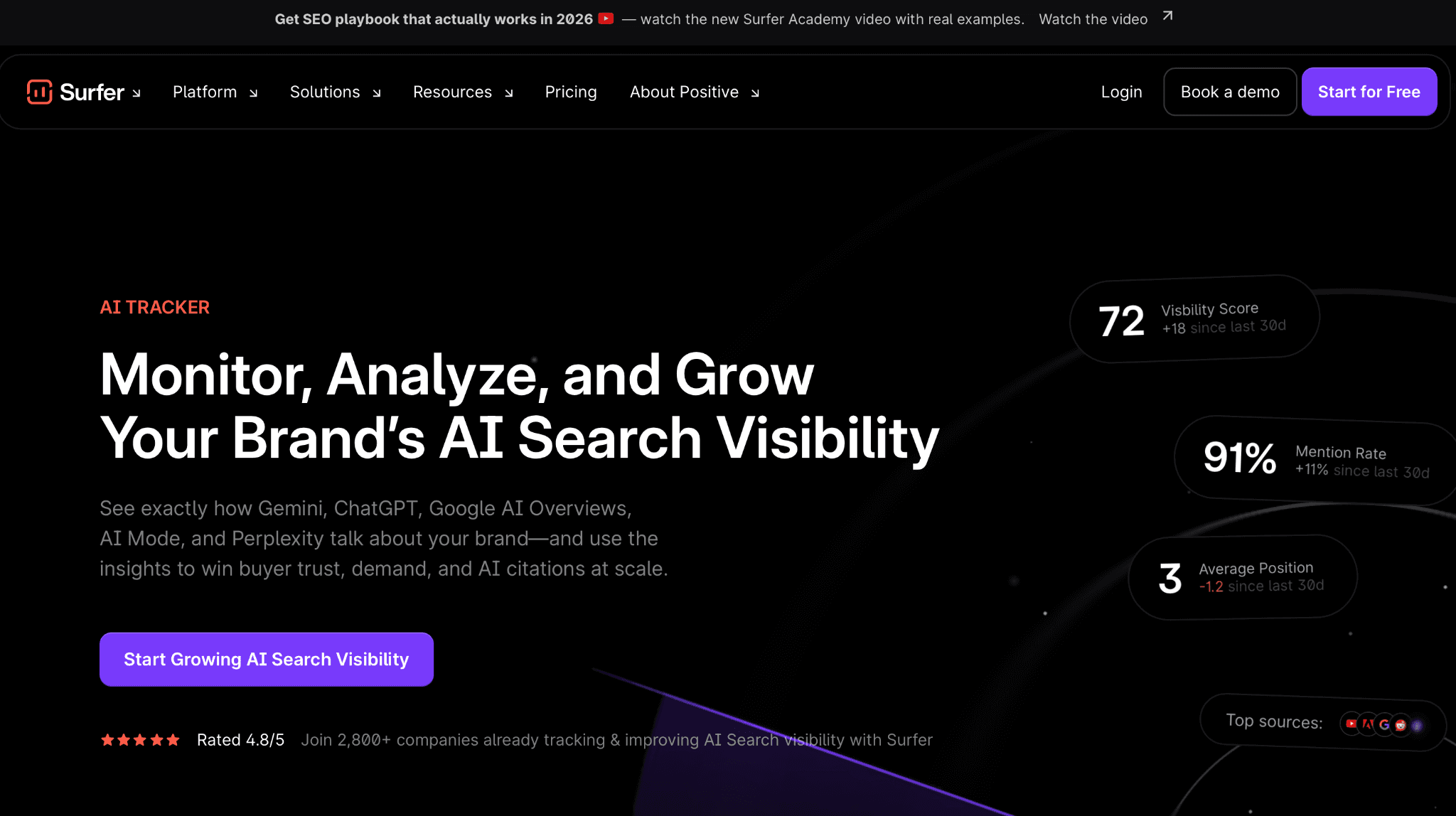
The tool monitors whether your brand shows up in AI-generated answers, tracks mention gaps where competitors get cited and you don't, and reports share of voice and sentiment, all inside the Surfer dashboard your content team may already live in.
Its real advantage is proximity to the writing. Because the Tracker sits next to Surfer's Content Editor, a gap it surfaces can flow straight into action: the AI Search Guidelines and one-click Auto-Optimize help you restructure a page with the entities and citable passages AI engines favor, then you publish and watch the Tracker for movement.
The honest limit is coverage. The Tracker leans on Google AI Overviews and Gemini, so it's strongest for Google's AI surfaces and thinner across ChatGPT and Perplexity, where a lot of buyers actually ask. Some independent testing has also questioned the accuracy of its snapshot-based readings, so treat the numbers as directional rather than precise.
Key features:
AI visibility tracking with mention gaps, share of voice, and sentiment in AI answers.
Tight handoff to Surfer's Content Editor, AI Search Guidelines, and Auto-Optimize for citation-ready rewrites.
Competitor citation tracking to see who AI names instead of you.
One dashboard shared with Surfer's full on-page optimization workflow.
Pros: Lives where your content team already works, an unusually direct path from gap to rewrite to republish, and useful Google-surface coverage.
Cons: It's a paid add-on, on top of your plan, so AI tracking isn't included in the base price. Engine coverage skews to Google (AI Overviews and Gemini), leaving ChatGPT and Perplexity thinner, and the snapshot methodology has drawn accuracy questions. As a standalone monitor it's narrower than purpose-built trackers.
Pricing: AI Tracker add-on $49/mo for 25 prompts. Requires a Surfer plan: Standard $99/mo, Pro $219/mo, Peace of Mind $359.
Verdict: The Surfer AI Tracker is the right call if you're already a Surfer user and want monitoring that feeds straight into your optimization workflow, that closeness to the writing is its genuine edge. But it's an add-on, not a standalone GEO platform: the per-prompt cost stacks up, and the Google-weighted coverage means you'll miss a lot of what happens in ChatGPT and Perplexity. If AI visibility across all the major engines is the priority, pair Surfer's writing tools with a dedicated tracker built for broad coverage.
G2 Rating: 4.8/5
15. SE Ranking
Best for: Agencies and SMBs already in SE Ranking who want AI tracking layered onto a full SEO suite.
About SE Ranking:
SE Ranking is a mature, value-priced SEO suite that has added AI search tracking as the category has grown.
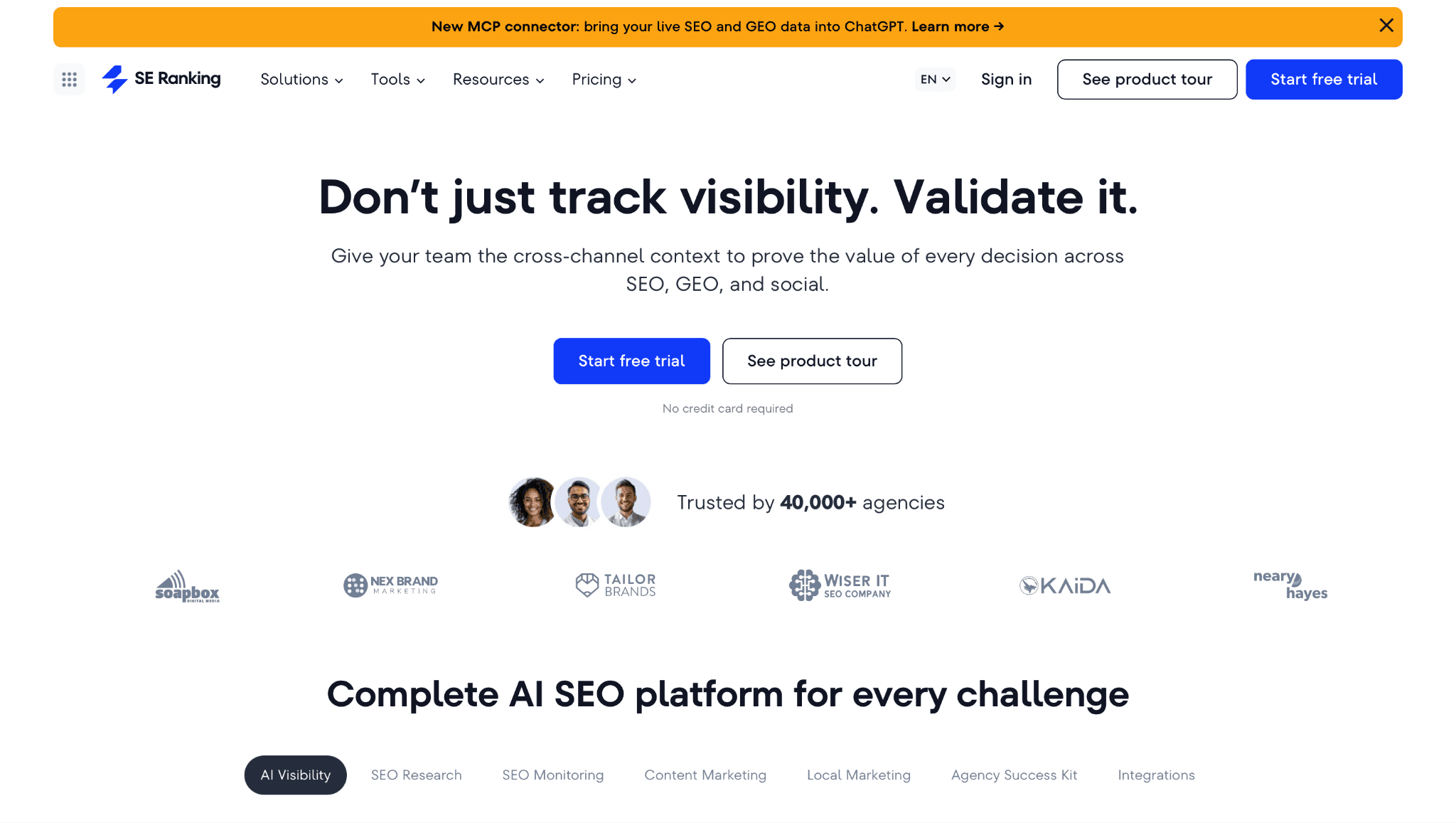
For an agency already running clients through it, the appeal is real: you get AEO monitoring, citation tracking, and competitor AI analysis without adding another vendor, plus an MCP connection that lets you query the data live inside ChatGPT or Claude.
The catch is structural. AI visibility in SE Ranking isn't one clean product. It's an add-on tracker inside the suite plus a separate platform, SE Visible, and the two differ on price, refresh rate, and engine coverage.
The in-suite tracker leans heavily on Google AI Overviews and AI Mode, while broader ChatGPT, Perplexity, and Gemini coverage involves add-ons or the standalone tool.
Key features:
AI Results Tracker for brand mentions and links in AI Overviews and AI Mode.
Broader LLM tracking (ChatGPT, Perplexity, Gemini) via add-on or SE Visible.
Full SEO suite: rank tracking, audits, keyword and competitor research.
White-label Agency Pack, plus API and MCP access for live querying.
Pros: Excellent all-in-one value, strong agency tooling (white-label, 188 countries), and AI tracking that's cheap to add if you're already a customer.
Cons: The advertised entry price is misleading for AI work, meaningful engine coverage pushes the real cost to roughly $150-240+/mo once add-ons or SE Visible stack up. The split between SE Ranking and SE Visible is confusing, several engines are still "coming soon" on the standalone, and refresh is weekly, not daily.
Pricing: Core ~$103/mo (annual) or $129 monthly, Growth ~$223/mo, Enterprise custom. AI tracking via add-on; SE Visible standalone ~$189/mo. 14-day free trial, no card.
Verdict: SE Ranking makes sense if you're already inside it or want one suite covering both classic SEO and AI search at a fair price. For an agency, layering AI tracking onto an existing seat is one of the cheaper ways to offer AEO. But if AI visibility is your main need, the add-on math, the dual-product confusion, and the weekly refresh make it a roundabout path, and a purpose-built tracker will give you broader engine coverage and a cleaner price.
G2 Rating: 4.7/5
What Makes a Good AEO Tool?
Here's the trap: almost every tool passes the obvious checklist. Visibility score, competitor chart, citation list, sentiment, daily dashboard, those are table stakes in 2026, not differentiators. Judge on that list and every tool looks identical, so you end up choosing on price or whoever ran the better demo.
The criteria that actually separate them are quieter. Four matter most:
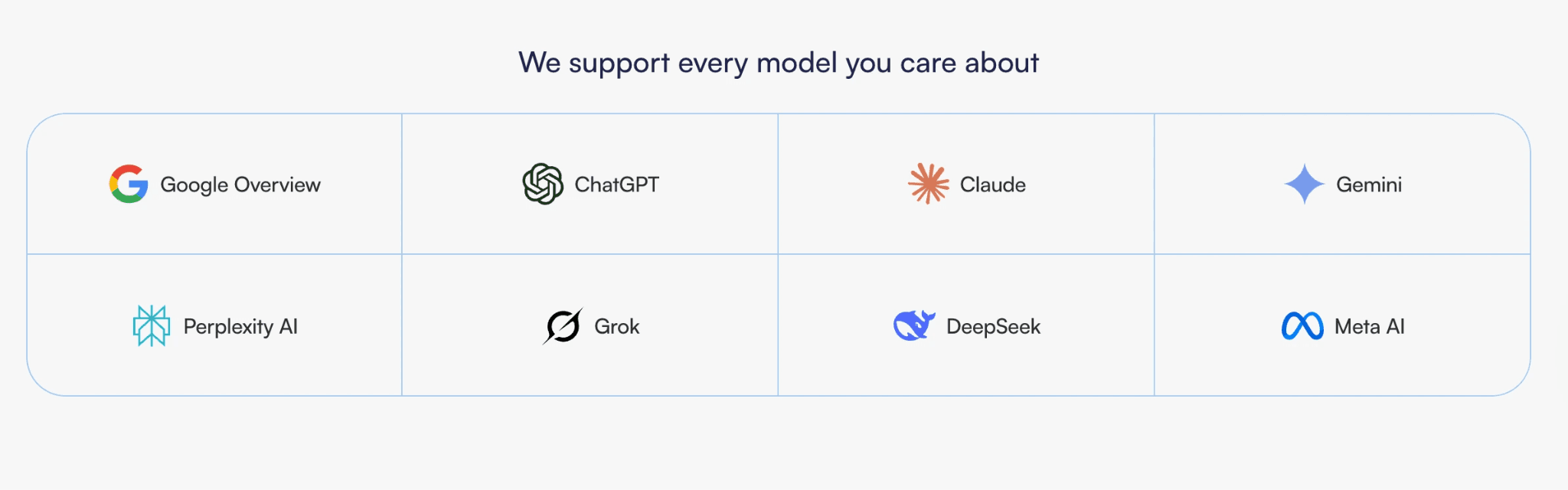
Engine coverage you'll actually use: How many engines you get on the plan you can afford, not how many the headline claims, versus what's gated behind add-ons.
How the data is collected: Real user interface (what a buyer sees) vs API sampling or modeled estimates. Know whether your score is measured or guessed.
What happens after the score: Does it tell you why you're invisible and what to fix first, or just that you are?
Whether it ties to real outcomes: Does it link AI visibility to GA4 traffic or revenue, or leave you with a number that proves nothing?
Everything else, prompt libraries, multilingual audits, clean exports, is useful but common. Judge on the four above and the field narrows fast.
How to Choose the Right AEO Tool
Different tools fit different needs. Here's how I think about it:
Solo marketers/founders: Start lean. AIclicks or Otterly gives you quick answers and weekly visibility checks without an enterprise bill.
Agencies: Prioritize prompt-level tracking, competitor benchmarking, and multi-client workspaces. AIclicks, Peec, and Rankscale fit here.
Enterprise brands: You'll want full dashboards, multilingual support, revenue attribution, and analytics integrations. Profound, Scrunch, and Gauge cater to this level.
Before picking, ask yourself:
Do you need a tool that just tracks, or one that tells you what to fix next?
Does your market span multiple languages or regions?
Are integrations with GA4, Slack, or export APIs must-haves?
Is the pricing flat-rate, or credit-based that climbs as you add engines and prompts?
Best Practices for Maximizing AI Search Visibility
An AEO tracking tool tells you where you stand. Moving the number is a separate job, and it comes down to a handful of things that actually work:
Answer the question in the first two sentences. AI engines lift self-contained passages. Lead with the direct answer, then explain, so a model can quote you without stitching paragraphs together.
Earn third-party citations, not just on-site content. Most AI answers pull from sources you don't own, Reddit threads, listicles, review sites. Getting mentioned where the models already look matters more than another blog post.
Keep content fresh. Pages updated in the last year make up the bulk of AI-cited results, and stale content decays faster in AI search than in Google. Refresh on a schedule.
Structure for machines. Clear headings, FAQ blocks, comparison tables, and schema markup make your content easier to parse and quote.
Build entity clarity. Make sure the facts about your brand, what you do, pricing, who you serve, are stated plainly and consistently across the web, so models don't fill the gaps by guessing.
Track, change one thing, re-check. Treat it like any other channel: measure, act on a single variable, then watch the next crawl. That feedback loop is the whole point of owning a tool.
The tools in this post show you the gaps. Closing them is content and PR work, done consistently.
Check out this video for more advanced tactics: https://youtu.be/HZFguwvDA8k?si=fdqfXdu_Y42D2r15
E-E-A-T Considerations for AEO
AI engines, like Google, lean toward sources that signal experience, expertise, authoritativeness, and trust. The difference with AEO is that a model decides this in a split second, then either cites you or doesn't. So the signals have to be unmistakable:
Show real experience: First-hand testing, original data, named authors with credentials. AI engines increasingly favor content that demonstrates someone actually did the thing, not summarized it.
Make claims verifiable: Answer-first content backed by reliable, citable data, with sources linked. A model is far likelier to quote a stat it can trace than an unsupported assertion.
Build authority off your own site: Mentions and citations on sources the engines already trust, Reddit, review sites, industry publications, do more for E-E-A-T than another self-published post.
Keep your facts consistent everywhere: When your pricing, positioning, and offering read the same across the web, models trust the picture. When sources conflict, they hedge or guess.
The best AEO tools help you see this, not just whether you appear, but how: sentiment, the context you're cited in, and which trusted sources mention you. That turns E-E-A-T from a vague principle into something you can actually track and improve.
Try the #1 AEO Tool: AIclicks
Here's the throughline after all 15: the dashboards have converged, so the tool that earns its budget isn't the one with the prettiest chart or the longest engine list. It's the one that tells you what to do next, and ideally helps you do it.
That's the gap AIclicks was built to fill. It tracks where you stand across 10+ AI engines, shows you which sources feed those answers, and hands you a ranked list of the content, citations, and Reddit moves most likely to move your visibility, at an entry price that doesn't meter every query.
If this whole post has you wondering where your brand actually shows up when buyers ask AI, that's a question you can answer today. Start a free 3-day trial of AIclicks, see your visibility score, and get your first list of what to fix.
The tools you choose matter less than the habit: track, act, re-check. Start anywhere on this list. Just start.
Frequently Asked Questions (FAQs)
1. What is an AEO tool?
An AEO (answer engine optimization) tool tracks and improves whether your brand appears in AI-generated answers from engines like ChatGPT, Perplexity, Gemini, and Google's AI Overviews. Instead of measuring where you rank on a results page, it measures whether the AI names, cites, or recommends you when buyers ask questions in your category.
2. Is AEO different from GEO and LLMO?
Well, not really, not in any way that should change which tool you buy. AEO, GEO, and LLMO are overlapping names for the same work: getting your brand into AI answers. AEO is the older, broader term (it predates generative AI, going back to featured snippets and voice search), while GEO and LLMO were coined specifically for large language models. The tools largely overlap regardless of the label. Also read our guide on GEO vs SEO.
3. How much do AEO tools cost?
Entry pricing runs from around $20 to $29/month for lean trackers up to custom enterprise contracts that aren't publicly listed. Most capable mid-tier tools land between $99 and $500/month. Watch the pricing model as much as the number: credit-based tools meter every query, and "all engines" headlines often gate the best engines behind add-ons, so the real cost is usually higher than the sticker.
4. Which AI engines should an AEO tool track?
At minimum, ChatGPT and Google AI Overviews, since those drive the most volume. Strong tools add Perplexity, Gemini, Claude, and Copilot, with Grok, DeepSeek, Meta AI, and Amazon Rufus mattering for specific niches. Beyond the core handful, more engines rarely change the picture, because the ones that matter overlap almost completely.
5. Do free AEO tools exist?
A few offer free audits or limited free tiers, and several provide trials without a card. They're useful for a one-time snapshot, but free tiers usually cap prompts and engines tightly, so they work better for testing the category than for ongoing tracking.
6. Can an AEO tool actually improve my visibility, or just measure it?
Most only measure. They tell you you're invisible and stop there. A smaller group closes the loop by showing you which sources feed the answers and handing you a ranked list of content and outreach actions to take, which is the difference between a vanity score and a tool that moves the number. AIclicks, Gauge, and Athena HQ sit in that second group.
7. Can I just check my AI visibility manually instead of paying for a tool?
For one brand and a handful of prompts, you can run them yourself occasionally. It stops working fast. AI answers shift daily, personalization skews what you see while logged in, and tracking ten engines across multiple markets and competitors by hand is a full-time job. The tools exist because the manual version does not scale.
Our Content:
15 Best AEO (Answer Engine Optimization) Tools to Track Your Brand in AI Search (2026)

Introducing AIclicks API (June 2026)

How to Use Reddit for AI Citations in 2026

How to Rank in AI Overviews (2026): Top 10 Strategies
Ads Intelligence, State-Level Tracking, and More (June 2026)
14 Best Generative Engine Optimization (GEO) Tools to Try in 2026
Any questions left?
Book a call here: